Inflationary Reheating
Marcos Alejandro García (Institute of Physics, UNAM)
The exponential expansion of the early Universe driven by inflation leaves it in a cold, empty state. When inflation ends, the energy density of the inflaton field must then be transferred into visible and dark matter and radiation, during the stage known as reheating. In this talk I will present an overview of the perturbative and non-perturbative techniques necessary to determine particle production rates, and the impact that these dynamics have in a selection of cosmological observables.
Transmission link
https://us02web.zoom.us/j/84800164418?pwd=ugwAwqpKSvFGRih3bbP5y6rIc99KXc.1
Meeting ID: 848 0016 4418
Passcode: 25497
Date: August 29th, 2024, at 13:00 hrs Mexico City
Pairs of commuting quadratic elements in the enveloping algebra and integrable systems with magnetic fields
Libor Snobl (Czech Technical University in Prague)
Motivated by the consideration of integrable systems in three spatial dimensions in Euclidean space with integrals quadratic in the momenta we first classify three dimensional Abelian subalgebras of quadratic elements in the universal enveloping algebra of the Euclidean algebra.
This classification allows leading order terms of the integrals that cannot be written in the famous classical form of [Makarov, Smorodinsky, Valiev and Winternitz, Il Nuovo Cimento A 10 (1967) 106184] which holds only for integrable systems with scalar potentials. We show explicit examples of integrable and superintegrable systems with these more general leading order terms, some of which are of actual physical interest, e.g. helical undulator in solenoidal magnetic field.
Next, we introduce recently classified integrable systems of ellipsoidal and paraboloidal type and compare their forms with and without magnetic field. We describe difficulties encountered in a similar analysis for conical type integrals.
Transmission link
Meeting ID: 889 3162 3000
Passcode: 585840
Date: April 25th, 2024, at 13:00 hrs Mexico City
Coalgebra symmetry and its applications
Giorgio Gubbiotti (Università degli Studi di Milano, Italy)
A long-standing problem in the theory of Integrable Systems is how to construct new integrable systems. For systems in Classical Mechanics a very proficient method was introduced by Ballesteros and Ragnisco in mid-90s. Such a method is based on the notion of coalgebra, and roughly speaking allows the extension of integrable systems in one-degree of freedom to an arbitrary number of degrees of freedom. In this talk I will review the fundamental ideas of this approach and present some novel applications also outside its original formulation.
Based on joint works with Danilo Latini, Benjamin K. Tapley, and Bert van Geemen.
Transmission link
https://us02web.zoom.us/j/86027564967?pwd=a21nNnNSeDd5UEZaZnhNQzJ6aXdxZz09
Meeting ID: 860 2756 4967
Access Code: 802179
Date: January 25th, 2024, at 13:00 hrs Mexico City
Construction of compact wave functions for two-dimensional excitons and trions
Juan Carlos del Valle (Drake University, USA)
Assuming the effective mass approximation and a logarithmic interaction between constituent charged particles (carriers), I will discuss the construction of compact and accurate wave functions that describe two- and three-particle complexes in two dimensions. Prime examples of these complexes are excitons and trions that appear in thin monolayers of Transition-Metal DichalCogenides (TMDCs). In the case of excitons, these wave functions led to 5-6 correct decimal digits in the energy and diamagnetic shifts. In addition, it is demonstrated that they can be used as zero-order approximations to study magnetoexcitons via perturbation theory in powers of the magnetic field strength. For the trion, making a comparison with experimental data for concrete TMDCs, I established that the logarithmic potential leads to binding energies <= 30% greater than experimental ones. However, it still captures the main features of the experimental binding energy. Finally, I will elaborate on the structure of the exciton wave function at small distances whose carriers interact via the celebrated Rytova-Keldysh potential. This piece of new information may lead to the construction of improved variational wave functions used to study larger complexes that appear in TMDCs.
Transmission link
Date: November 30th, 2023, at 13:00 hrs Mexico City
Novel transport effect for Dirac Materials in parallel electric and magnetic fields
Alfredo Raya Montaño – UMSNH
Within a Supersymmetric Quantum Mechanics (SUSY-QM) framework, the (3+1) Dirac equation describing a Dirac material in the presence of external parallel electric and magnetic fields is solved. Considering static but non-uniform electric and magnetic profiles with translational symmetry along the y-direction, the Dirac equation is transformed into two decoupled pairs of Schrödinger equations, one for each chirality of the fermion fields. Taking trigonometric and hyperbolic profiles for the vector and scalar potentials, respectively, we arrive at SUSY partner Pöschl-Teller-like quantum potentials. Restricting to the conditions of the potentials that support an analytic zero-mode solution, we obtain a nontrivial current density perpendicular to the electric and magnetic fields, thus, defining a plane where these three vectors become coplanar, indicating the possibility of realizing the Planar Hall Effect. Furthermore, this non-vanishing current density is the sum of current densities for the left- and right-chiralities, suggesting that the net current is a consequence of chiral symmetry.
Transmission link
https://meet.google.com/vyh-wifg-tvz
Date: September 28th, 2023, at 13:00 hrs Mexico City
Haantjes geometry and beyond: integrability and applications to classical Hamiltonian systems
Piergiulio Tempesta – Universidad Complutense de Madrid (UAM )and Instituto de Ciencias Matemáticas (ICMAT)
We propose a new, infinite family of tensor fields, whose first representatives are the classical Nijenhuis and Haantjes tensors. We prove that the vanishing of a suitable higher-level Haantjes torsion is a sufficient condition for the integrability of the eigen-distributions of an operator field on a differentiable manifold. This new condition, which does not require the explicit knowledge of the spectral properties of the considered operator, generalizes the celebrated Haantjes theorem, because it provides us with an effective integrability criterion applicable to the generic case of non-Nijenhuis and non-Haantjes tensors.
We also propose a tensorial approach to the theory of classical Hamiltonian integrable systems, based on the geometry of Haantjes tensors. We introduce the family of symplectic-Haantjes manifolds as a natural setting where the notion of integrability can be formulated. In particular, the theory of separation of variables for classical Hamiltonian systems can also be formulated in the context of our new geometric structures.
Transmission link
Date: May 25th, 2023, at 13:00 hrs Mexico City
The continuity equation in the phase space quantum mechanics
Jaromir Tosiek – Lodz University of Technology
The talk is devoted to representation quantum systems with discrete internal degrees of freedom on a phase space. We remind shortly the correspondence between the Hilbert space model of quantum system and its symplectic counterpart and then we present a construction of a grid being a discrete phase space. Next we analyse simple examples of nonrelativistic and relativistic systems with discrete internal degrees of freedom. Finally we introduce the continuity equation on the quantum phase space.
Transmission link
Date: April 13th, 2023, at 13:00 hrs Mexico City
Non-equilibrium aspects of quantum field theories
Diptarka Das – Indian Institute of Technology
We shall review some universalities that occur in out of equilibrium set ups and how effective thermal descriptions sometime emerge. In the context of conformal field theories we point out the relationship between thermalization and bootstrap. We end with some comments on operator mixings in the context of quenches in field theories.
Transmission link
Date: March 23rd, 2023, at 13:00 hrs Mexico City
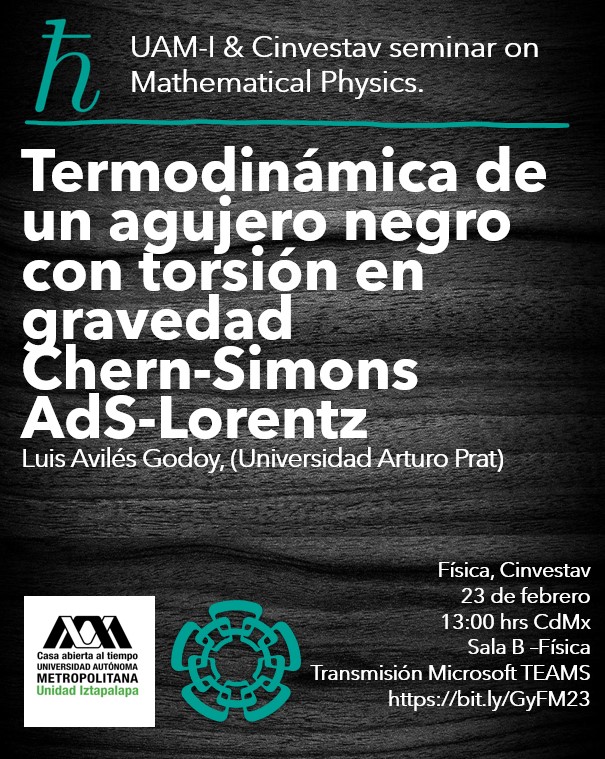
Termodinámica de un agujero negro con torsión en gravedad Chern-Simons AdS-Lorentz
Luis Avilés Godoy, (Universidad Arturo Prat)
Gravedad Chern-Simons AdS en tres dimensiones puede ser extendida a gravedad AdS-Lorentz a través de un procedimiento de expansión del álgebra so(2,2). Esto implica la introducción de un campo dinámico extra en la teoría, el cual resulta ser la contorsión del espacio-tiempo. En este seminario se presentará una solución de agujero negro con torsión no nula en este contexto, se mostrará la estructura asintótica asociada a dicha configuración y se discutirá cómo la torsión modifica las propiedades termodinámicas del agujero negro.
Transmission link
Date: February 23rd, 2023, at 13:00 hrs Mexico City
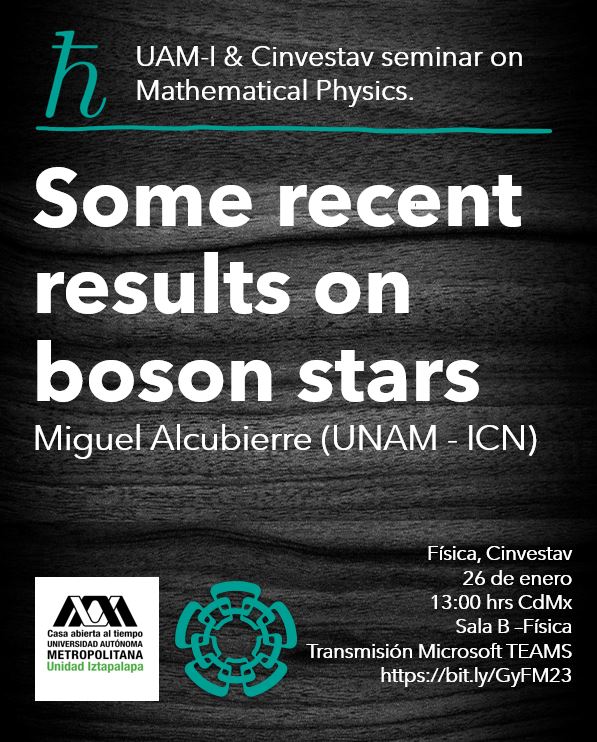
Some recent results on boson stars
Miguel Alcubierre (UNAM – ICN)
En esta charla se discutirán las «estrellas l-bosones”, que son soluciones auto-gravitantes estacionarias de sistema Einstein-Klein-Gordon para un número impar de campos escalares que tienen momento angular pero preservan la simetría esférica. También se discutirán algunos resultados recientes en el estudio de estrellas de botines con carga eléctrica.
Transmission link
Date: January 26th, 2023, at 13:00 hrs Mexico City
 Seminario de Gravitación y Física-Matemática Cinvestav & UAM-I & UMNSH